


The American Civil War did not end quietly. Its final ten months were a bloody climax that drowned the nation in death, strife, and blood. New horrors and hatreds boiled to the fore and forever left their mark on all who survived the terrible ordeal. Men who once called themselves countrymen slaughtered each other in Virginia dirt and Georgia clay for home and hearth, kin and comrade, and abstract causes that drove them mad. Amidst the tempest of battle were forged legends of military prowess that awe the mind and make the voice tremble. These were times of unimaginable suffering, of dizzying political and military development, of which was birthed America as we know it today. This is a tale of those times, a humble attempt to honor the deeds of greater men long dead and commit them to collective memory. The past is a selfish mistress who jealously guards her wards; they are forever silent and can no longer tell their stories. Their written words and the lasting mark of their deeds are our only guide. It is our duty as Americans, North and South, to commit these stories to paper and memory, to make the mortal into the immortal, and to remind future generations and upstart arrivals of the gravity and respect that these men and their deeds deserve.
– John Esten Cooke
It begins with fire on the mountain. Before dawn on May 4, 1864, the Confederate signal station at Clark’s Mountain, overlooking the Rapidan River and the sprawling encampments of the Union Army of the Potomac on the river’s northern shore, lights a signal fire to warn Robert E. Lee that the summer campaign season is officially beginning. It has been nearly 11 months since the titanic clash at Gettysburg left the Confederate Army of Northern Virginia smarting from the loss of over 28,000 men. In the time between July 1863 and May 1864, the Army of Northern Virginia and Army of the Potomac have shadowboxed across a front spanning more than 90 square miles with no result. After a mutually frustrating summer and fall campaign, the two armies settle into a staring match along the winding banks of the Rapidan and Rappahannock Rivers. For a brief moment, an uneasy peace has returned to war-ravaged Virginia. The fire on Clark’s Mountain is a portend to an end of that peace and a resumption of hostilities between the Blue and the Gray.
The Gray
Gettysburg has wounded them. The privations of the previous winter have weakened them. These men have suffered much since the heady days of the previous June, when they marched triumphantly into Pennsylvania. Lee’s gaunt army is no longer the same force that carried the field at Manassas and Chancellorsville. On May 2, the Army of Northern Virginia’s returns list a strength of 66,000 men across the three infantry and one cavalry corps.
The Army has been enmeshed in a chronic food shortage since the autumn of 1863. Daily rations for each soldier amount to a handful of wheat bran and beef so poor in quality that it smells like glue. These men are no stranger to privation and hunger, not by the war’s fourth summer, but the winter they have endured has stretched them to their limits. The incompetency of Lucius Northrop, Commissary-General of the Confederacy (and personal friend of President Davis), the ever-strengthening Union blockade, and the ravages of war upon the fertile farmlands of the Southern states have all constricted the fledgling Confederacy’s ability to feed its own army.
Forced to spread his army out due to food shortages, Robert E. Lee has endured a year of personal hardship and frustration. When he is not facing the enemy on the field of battle, Lee often engages in a war of words with the Confederate government over the condition of his army and Richmond’s tendency to strip him of valuable troops to defend secondary theaters in Virginia and North Carolina. Much needed men are detached to defend the Virginia and Carolina coasts, weakening the already outnumbered Southern force that faces off against the Union host.
In addition to food shortages, the Army of Northern Virginia is faced with a shortage of its most important and necessary resource: manpower. By February 1864, Richmond tacitly admits that the South is bled dry and institutes mandatory conscription for all White males aged 17 to 50. While these conscription measures do yield some fresh recruits for the manpower-starved Confederate formations in Virginia and Georgia, the South will go into the war’s fourth summer outnumbered on all fronts by margins of 2 or 3 to 1.
Though the soldiers of the Army of Northern Virginia lack provisions, they remain steadfast in their faith in their commanding general. Robert E. Lee is the South’s finest military champion, and with his person lies the last remaining chance for the fledgling Confederacy’s desperate bid for independence. His soldiers are aware that their foe outnumbers them in men, guns, and horses, that the Yankees across the river are far better provisioned and want for neither food nor shot. Even still, the men in gray are confident that once battle is joined again, their commanding general will put the invader to rout once more. Their belief in General Lee — “the Old Man” — is absolute. He is almost like a father to them. They have charged all but Hell itself for him time and time again and are resolved to do so once the enemy crosses the Rapidan.
The Blue
Gettysburg has given them a taste of that which they have sought for so long: victory. The Army of the Potomac is a different force compared to its main antagonist; indeed, the Army of 1864 is a different force from that which triumphed in Pennsylvania last summer. It is a polyglot force of volunteers, conscripts, bounty hunters, immigrants fresh off the boat, abolitionist zealots, and a core of veteran soldiers who have bled for three summers to preserve their beloved Union.
Unlike their counterparts in gray, the soldiers of the Army of the Potomac do not suffer chronic want of food and forage. They are well fed, well provisioned, and well armed with modern weaponry: rifled cannon, rifled muskets, and an increasing prevalence of repeating rifles that outmatch any small arm carried into battle by their foes.
As has happened several times, the Army begins its march under the watchful gaze of new leadership. George Meade, the hero of Gettysburg, still commands the Army, but joining him is a new presence, one whose name had previously only been known to the soldiers through the written word of the newspaperman.
Fresh off his promotion to Lieutenant General by President Abraham Lincoln, Ulysses S. Grant, conqueror of Vicksburg and hero of Shiloh and Chattanooga, arrives in Washington in February to assume command of all Union armies in the field. Having correctly deduced that the 90 miles between D.C. and Richmond remain the war’s critical battlefront, he elects to join Meade and the Army of the Potomac for the coming summer campaign. Grant intends to allow Meade to exercise command of his army and wishes merely to observe the coming fight if possible. He has no desire for the complex political machinations that have come to define the Army of the Potomac’s command structure. As General of the Armies, he must exercise authority over troops from Virginia to Louisiana, and his plan for 1864 is to do just that.
Having learned from the setbacks suffered in Georgia in 1863, Grant resolves to bring the North’s overwhelming advantage in manpower to bear against the South. All along the frontier between North and South, the Union armies will advance into the heart of the Confederacy at once, denying the ability of the South to use interior lines to shift troops from quiet theaters to more threatened ones as happened at Chickamauga in September 1863. From Louisiana to Atlanta, the Shenandoah Valley to the Virginia coast, massive Federal armies prepare to descend upon the remaining vestiges of Confederate territory. The South will have no chance to concentrate her scarce manpower or mobilize an effective defense. As the coup de grâce, Meade and Grant will seek out Robert E. Lee and bring him to battle in Northern Virginia. With luck, the rebellion will be crushed in one swift stroke, and the most devastating war on the North American continent finally brought to a close.
Grant’s Plan
Resolved to bring Robert E. Lee to battle and destroy him, Grant and Meade spend the spring months poring over maps of Northern Virginia and pondering the best route by which to resume the march on Richmond. It is Meade who first suggests a variation of a previous Union campaign plan: to cross the Rapidan north of the town of Fredericksburg and march south to get between Lee and Richmond. Once in position, the Army of Northern Virginia will have no choice but to engage the Army of the Potomac on ground of Meade’s choosing. Given a second chance to fight a Gettysburg-style engagement, Meade is certain of his army’s chances of success.
At first, Grant is hesitant. Meade’s plan is not new or original; it is almost the exact same plan proposed and executed by the disgraced Joseph Hooker, who met with disaster and misfortune when his attempt to cross the Rapidan culminated in the Union defeat at Chancellorsville. Nevertheless, Meade is persistent, and wins Grant over to his strategy by listing out the advantages to such a move.
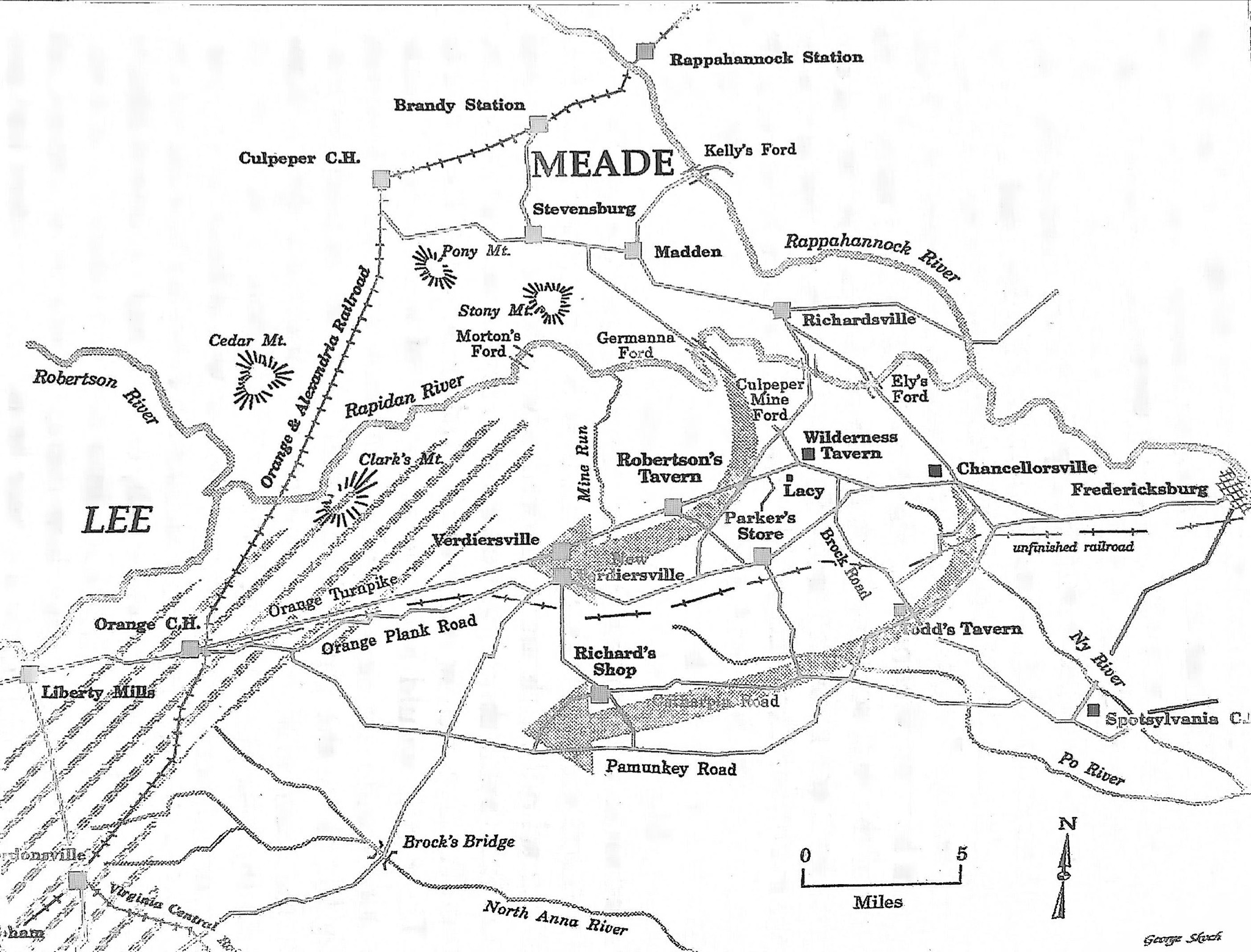
First, by moving “to Lee’s right,” the Army of the Potomac will have the Rappahannock River to its back, allowing for easy riverine transport of supplies and ammunition as they become needed. Second, such a maneuver allows the Union army to cover Washington, D.C., even as it moves farther south. Finally, a march down eastern Virginia allows for the Army to take a direct shot at Richmond and tear the heart out of the Confederacy. One major obstacle haunts the Army of the Potomac’s commander as he plans his move under Grant’s watchful eye.
The Wilderness of Spotsylvania is a near-impregnable tract of second-growth forest and dense shrubbery. The Union army has twice met with frustration within its depths: it was from out of that dark forest that Stonewall Jackson’s Confederates emerged liked ghosts to crush the flank of the Union army at Chancellorsville, and it was within its depths that Meade and Lee sought battle with futility during the Mine Run campaign of the previous autumn. The forest is so dense that large maneuvering formations of men are limited to the use of the few roads that crisscross its primordial depths. The only landmarks of value are the odd farmer’s field or crossroads buildings — stores, churches, etc. — that give a traveler any point of reference by which to orient himself. Within the depths of the Wilderness, the advantage of the Union army’s rifled artillery and superior numbers will be naught.
The success of Grant’s flanking maneuver will hinge on the ability of the Army of the Potomac to march south through the dense forest before Robert E. Lee can march east and confront them. Meade’s worst fear is to have his troops caught on the march in the middle of the Wilderness; unable to maneuver and support one another, the Union corps risk being defeated in detail. With the presidential election a mere six months away, any setback for the North risks the reelection chances of Abraham Lincoln and the ascension of a peace candidate who will grant the South’s desire for independence in order to stop the bloodshed.
Marching south through the Wilderness as quickly as possible, the Union troops will pivot west once they reach the Orange Turnpike and Orange Plank Road, overrun the formidable trenches at Mine Run before the enemy can occupy them, and slam into the still marshalling Confederates in open country to the west of the Wilderness. By outflanking the Southern defensive lines and flushing the Confederates out of the Wilderness and Mine Run fortifications, the destruction of the Army of Northern Virginia will be concluded with minimal Federal loss. It is a good plan, an ambitious plan, and one that suits the aggressive mind of General Ulysses Grant. But no plan survives first contact with the enemy.
Lee’s Plan
Around noon on May 2, Robert E. Lee and the corps and division commanders of the Second and Third Corps1 ascend Clark’s Mountain. From the commanding view of the mountain’s summit, they can clearly see the Army of the Potomac stirring in its encampments. After sweeping the vista before him with his binoculars, he predicts that Grant “will cross the Rapidan, perhaps at Germanna and Ely’s Ford.” He instructs his subordinates to prepare their commands for a march into the Wilderness.
The Army of the Potomac begins its march 36 hours later. By sunrise, the lookouts on Clark’s Mountain can see the massive blue columns snaking their way across the Rapidan and disappearing into the distant green mass of the Wilderness. The Confederate scouts immediately light the signal fire to warn their comrades of what is coming. This flicker of orange light is noticed by Union signal troops across the Rapidan, and Meade and Grant are soon alerted that their maneuver has been detected.
It begins with fire on the Mountain.
Advance to Contact
The first shots of what will become known as the Overland Campaign are fired from a group of soldiers belonging to the 1st North Carolina cavalry. The Confederates’ targets are the vanguard of General James Wilson’s cavalry division, in the midst of crossing Germanna Ford. They are the first wave of the massive Union infantry column currently sorting itself into a march formation that will stretch for miles.
The initial volley from the North Carolinians provokes a furious counterattack. Union horsemen draw their sabers and charge. The North Carolinians, realizing that what they are facing is no mere raid but something far larger, mount their horses and scurry into the darkness.
It is 3 in the morning on May 4.
Wilson spurs his column of horsemen south at a rapid pace. An engineer by training, brought east by General Grant, he is a natural combat commander and has the complete trust of the commanding General as well as Phil Sheridan, commander of the Army of the Potomac’s cavalry. Wilson’s objective for May 4 is to screen the flank of Warren and Sedgwick’s columns as they cross Germanna Ford into the Wilderness, and to reach and secure Wilderness Tavern, a small outpost at the crossroad of the Germanna Plank Road and the Orange Turnpike.
At the same time that Wilson’s troopers are driving away the menacing North Carolinians, the first elements of Hancock’s troops cross the Rapidan River at Ely’s Ford and make for the silent, ruined edifice of Chancellorsville. His corps is screened by the cavalry division of General David Gregg.
The Federal march has been ongoing since midnight. The idea is to get as much of a head start on Lee as possible, to minimize the time that the Army of the Potomac will be vulnerable as it marches through the Wilderness. Under the cover of darkness, Federal engineers throw up massive pontoon bridges across the river to speed the rate of advance. By the time the sun claws its way into the eastern sky, the Union army is already in the midst of its crossing. The sight greeting the Confederate lookouts on Clark’s Mountain is breathtaking: blue columns snaking their way north and south, as far as the eye can see. The heads of the columns — Warren’s vanguard — are snaking toward the distant green tangle of the Wilderness.
Signal troops on the north side of the Rapidan spot the Confederate signal fires at 9:30 A.M. Grant and Meade are quickly notified. Meade, anxious with anticipation, has barely slept and is agitating for his army to cross the Rapidan as soon as possible. The success of the Union offensive depends on their ability to pass through the Wilderness into open country to the south.
Union progress on the morning of May 4 is good. Winfield Hancock’s 2nd Corps, which crosses the Rapidan River farther east at Ely’s Ford, reaches the burnt-out ruins of Chancellorsville at 9:50 A.M. — his objective for the first day of Operation Wilderness. The sight that greets the arriving Union soldiers is grim; everywhere amongst the charred ruins of the once-grand house and strewn about the crossroads and clearing are the skeletal remains of man and beast. Veteran soldiers, some of whom fought on this very ground, wonder if this or that skull is the remains of a comrade hastily buried during the previous May. The new recruits look into the empty eye sockets of the slain and wonder if they too will share the same fate.
Lee Marches East
The signal fire on Clark’s Mountain ignites a frenzy of activity in the Southern camps. The Army of Northern Virginia has been stirring from its winter slumber ever since the lookouts on Clark’s Mountain detected the signs of the Army of the Potomac’s mobilization on May 2. The artillery limbers, hitching horses to cannons and caissons. Fitz Lee’s cavalry division, spread out all along the Rapidan from Germanna Ford down to Fredericksburg, provides Robert E. Lee with a steady stream of information as to the progress of the Union army as it moves south into the Wilderness and Chancellorsville areas. The intrepid gray horsemen avoid battle with their blue counterparts in Wilson’s division as it pushes west down the Orange Plank Road.
The news that the enemy army is on the march finally prompts Lee to decide as to how he will meet Ulysses S. Grant in battle. Out of the question is the possibility of disengaging and moving farther south; as Lee sees it, doing so will delay the inevitable confrontation and move the front ever closer to Richmond. The only option is to march east and meet the enemy in battle. Lee is still unsure of how exactly such a meeting will develop. What he cannot do is surrender the initiative to the larger Federal army as it moves on his flank.
The soldiers of the Second and Third Corps are ordered to prepare three days’ rations and file into march column along the Orange Turnpike and Orange Plank Roads. Longstreet’s corps, farther south near Gordonsville, is ordered to march to rejoin the rest of the army with all possible haste. For the two Confederate formations closest to the enemy — Ewell’s and Hill’s troops — the march toward the Mine Run earthworks begins at 11:00 A.M. Riding at the head of Hill’s column on the Orange Plank Road, Lee sets a brisk pace for the Third Corps. There is no time to lose.
“Enemy has struck his tents,” reads a telegraph sent to Richmond. “Infantry, artillery, and cavalry moving toward Germanna and Ely’s Fords. This army in motion toward Mine Run. Can Pickett’s division move toward Spotsylvania Court House?”
No reinforcements can be sent yet, and Lee must pull his army — scattered by necessity — together quickly and do so while on the march. His cavalry, in a welcome reversal from its dismal performance in Pennsylvania, sends constant reports on May 4 as they skirmish with Union horsemen and glimpse Federal infantry pushing into the Wilderness.
Grant Crosses the Rapidan
Ulysses Grant, astride Cincinnati, his war horse, crosses Germanna Ford shortly before noon, to the cheers of marching soldiers who holler and wave their hats as he passes. Accompanying him is an entourage of newspapermen, staff officers, and Congressman Elihu Washburn — Grant’s political mentor who sends a steady stream of updates to Washington.
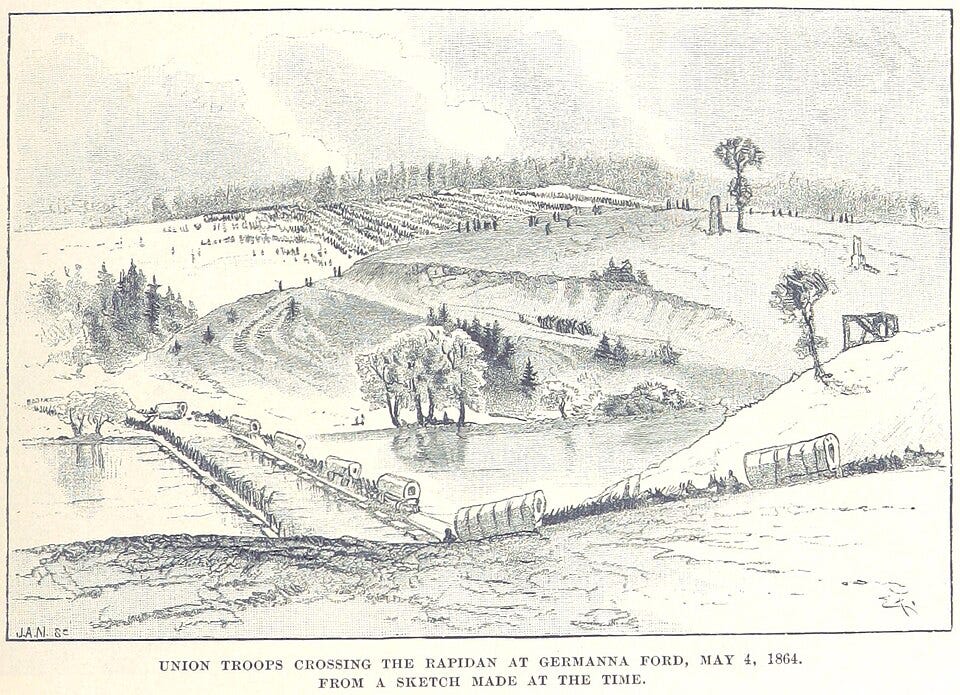
Setting up his headquarters with Meade on the south bank of the river, Grant notices the brand-new headquarters flag of General Meade — a golden eagle in a silver wreath on a lavender backdrop. Smoking a cigar, a bemused Grant asks Meade, “What’s this? Is Imperial Caesar anywhere about here?”
The two men confer quietly as John Sedgwick’s 6th Corps begins to file past, following Warren’s 5th Corps into the Wilderness. A steady stream of couriers from Hancock — five miles away at Ely’s Ford — keep Grant and Meade apprised as to the progress of the 2nd Corps.
For both wings of the Army of the Potomac, the march is grueling. Having started at midnight, some of the soldiers have marched 25 miles by noon. Discarded overcoats and blankets line the road as desperate soldiers try to lighten their loads. Following artillery and supply units happily help themselves to the discarded contents of the infantry. As the day progresses, more and more knapsacks are slung from the barrels of Union cannon.
Grant and Meade anxiously await news from the signal troops watching Clark’s Mountain and the Confederate troops manning the Rapidan line. All day, a flurry of signals from Clark’s Mountain are decoded. About the same time as Grant crosses the Rapidan to join with Meade, a decoded message to Ewell is brought before them.
We are moving.
Meade, having fought Robert E. Lee as a commanding general for the better part of the year, knows what is coming. He advises Grant that the decoded message means that Lee is coming to meet them and will not sit passively behind his fortifications along the Rapidan. For not the first time — and to his growing annoyance — Grant is reminded that Robert E. Lee is not Braxton Bragg or John Pemberton or Joe Johnston. He is not one to surrender the initiative, and he never backs down from a fight.
“This is just the information I wanted,” Grant remarks upon learning of the decrypted message. “It shows Lee is pushing out to meet us.”
The Army of the Potomac is making perfect time. Hancock and Warren have crossed by midmorning and are reaching their first days’ objectives. Union cavalry under Generals Wilson and Gregg have pushed deep into the Wilderness and have kept their Confederate counterparts from interfering with the Army’s movements. The 2nd, 5th, and 6th Corps have made excellent time and reached their first day objectives without incident or delay. As the Federal commanders see it, the news that Lee is marching to meet them does not require the alteration of Operation Wilderness. They have stolen the march on Lee and now know precisely where the Confederate commander is headed.
Cavalry Maneuvers
The afternoon of May 4 is dominated by the cavalry maneuvers of James Wilson’s Union cavalry division, tasked with screening Hancock’s 2nd Corps and pushing west to find the Army of Northern Virginia.
By morning, advance elements of the Union cavalry have pushed west down the Orange Plank Road to a small collection of wooden buildings called Parker’s Store. Upon reaching the store, Wilson turns his column south, leaving behind a small detachment of the 5th New York Cavalry to screen the Orange Plank Road. Wilson, a former infantry commander newly assigned to the cavalry, is unsure of himself and unfamiliar with the requirements of commanding a formation of mounted horse. Whether by fate or a lack of judgment, he leaves one regiment to guard the road by which A.P. Hill’s corps is approaching to slam into the march columns of the Army of the Potomac.
Evening of May 4
As the sun begins to settle below the horizon, the soldiers of Ewell’s and Hill’s corps make camp in the vicinity of the Mine Run entrenchments. Erecting his headquarters tent near the home of Mrs. Rhodes in New Verdiersville, Lee takes stock of the situation facing him and of late-evening intelligence brough to him by Jeb Stuart. As Wilson and Gregg’s cavalry screens push west during the afternoon, the intelligence from Lee’s cavalry begins to dry up as the Confederate horsemen are pushed east toward their own lines.
All that is certain by evening of May 4 is that Union cavalry is moving west and south in force, and that Union infantry continues to move south into the Wilderness. What Lee must know is the direction of march of the infantry: Are they moving south to Richmond, southeast to Fredericksburg, or west to confront him?
Resolved not to wait idly while his opponent plans his destruction, Lee resolves on the evening of May 4 to continue the march east on the morning of May 5. As he sees it, the initiative hangs in the balance, and the chance to strike at the Army of the Potomac while it is out of position is an opportunity too great to pass up. It is a massive risk.
Lee will be engaging the Army of the Potomac, whose exact strength and dispositions he does not know, with fewer than 35,000 men in five divisions. Longstreet is still not up with the army, and one of Hill’s divisions under Richard Anderson is still watching the Rapidan line in case Grant tries to force a crossing of the river in Lee’s rear. But, knowing that the formidable trenches of Mine Run offer a good position to fall back on, Lee assures himself that the risk of seeking battle on the 5th is worth the reward. If he is lucky, he will pin the Army of the Potomac in the Wilderness and neutralize its numbers and artillery. Then, with the Union troops stuck and disorganized in the thick terrain, he will unleash Longstreet’s veterans and annihilate the Army of the Potomac under the canopy of this dark forest.
Here, then, is a chance to reenact Stonewall Jackson’s flanking maneuver at Chancellorsville, nearly a year to the date of the event. Here lies the opportunity long denied him: to catch his foe in a position where he may be decisively defeated and send the invader back across the river. The gamble is enormous; Lee will have to prevent his army’s destruction in detail on the morrow while his reinforcements march to the sound of the guns. Should he fail, then the Army of Northern Virginia — the South’s last, best hope of independence — will face the destruction he wishes to inflict on Ulysses S. Grant.
But Lee knows that the stakes demand nothing less. Every day, he can feel his beloved Virginia grow weaker as she is ravaged by endless war. Every day, he can see the fledgling Confederacy crumble against the superior economic and industrial might of the North. Once it was hoped that the Old World would ride to the rescue of the fledgling Confederate nation. That hope died a slow death, first at Sharpsburg, then with Jackson, and finally amidst the roar of Meade’s cannon on July 3 at Gettysburg’s stone wall. The last hope left, the only hope, is to outlast the enemy, to inflict such a blow upon the Union’s military might that the Northern populace abandons the war and the Radical Republicans in the White House and Congress are swept from power in the upcoming November election. Everything hinges on what will transpire in Virginia over the coming days.
Shortly after dark, Grant and Meade huddle around a campfire and go over the day’s events. A faulty report places Jeb Stuart’s cavalry near Fredericksburg; fearing for the safety of his lumbering supply trains, Meade orders Sheridan to peel off most of the Union cavalry and assign it to guard the supply trains. Sheridan bristles but complies.
By letting his paranoia of Jeb Stuart get the better of him, Meade unknowingly exposes his right flank to Robert E. Lee by leaving only Wilson’s cavalry division — the smallest division in Sheridan’s command — to cover the entire frontage of the Army of the Potomac. Not only does Wilson lack the numbers to do so, but he is also dangerously out of position and out of his depth in executing such a task. The ambitious march routes for the infantry are suspended. Instead of continuing south and then swinging west, the Army of the Potomac will establish itself on a convex line from Germanna Ford to Shady Grove Church. Warren is to move to Parker’s Store and connect with Hancock, while Sedgwick is to take up Warren’s old position astride the Orange Turnpike. Burnside, late as always, is to force-march the 9th Corps to rejoin the Army of the Potomac.
If Burnside were to join the army, Grant and Meade’s numbers would swell to over 120,000 men, but at the cost of surrendering the better part of a day of maneuvering and the initiative.
All day, the crowd of newspapermen have pestered Grant with questions. Sylvanus Cadwallader of the Chicago Times asks perhaps the most famous question:
“General Grant, about how long do you expect it will take you to get to Richmond?”
“I will agree to be there in three to four days,” Grant replies with a smile, “provided if General Lee becomes a party to the agreement. But if he objects, the trip will undoubtedly be prolonged.”
Meade’s paranoia aside, the mood at army headquarters is confident on the night of May 4. Within a day, Grant will have his entire army to throw against Lee, who according to reports is merely filing into the old position at Mine Run. Grant stays awake until midnight, reviewing dispositions with Meade, before he retires to his tent to catch a few hours of sleep.
To the south, a lone infantryman of the 6th Corps sees the faint flicker of campfires to the west and the unmistakable dark pall of smoke climbing above the canopy of the Wilderness. He alerts his superior officer, who brushes him off by insisting that it is just Federal cavalry. The vigilant soldier is sternly warned not to discharge his weapon or cause any undue panic, and that anyone out to the west doubtlessly wears Union blue.
It is actually the infantry of Dick Ewell’s Second Corps, settling around their campfires for supper and to get a few hours of sleep. The veterans in gray are eager for the fight that is expected tomorrow. As Grant predicted, Robert E. Lee and the Army of Northern Virginia do indeed “object to the arrangement,” and tomorrow they intend to make their objections known.
Thumbnail image: Kurz & Allison, Battle of the Wilderness; Desperate Fight on the Orange C.H. Plank Road, Near Todd’s Tavern, c. 1887
Confederate corps titles are spelled out; Union corps titles are in numerals.
