
Primordial Truth
Or, Why ‘Warhammer’ Is the World

“All I ever wanted was the truth. Remember these words as you read the ones that follow.”
– The Book of Lorgar
I was inspired by the recent podcast episode on J. Burden’s channel featuring Kevin DeAnna. In it, they describe the qualities of the Warhammer universe and why it speaks so deeply to us. Indeed, one finds that a common enough question when interacting with new frens is “What Warhammer faction did you play?” Physiognomy is real, but so is Warhammer physiognomy. What faction someone played is greatly revealing about his personality. Most people tend to play Space Marines of one form or another. There are a lot of Dark Angels players in the OGC, so take that for what you will. Personally, I played Imperial Guard when I actively was still playing Warhammer 40K. There is something very archetypical of the Warhammer universe, so naturally, individual humans are drawn to the all-too-human archetypes present in the story. For the purposes of this article, I will focus on some of the deeper significances of the Warhammer setting as they relate on a mystical or symbolic level rather than the prima facie political significance.
I believe that Warhammer is the world, symbolically speaking. In more recent iterations of lore, especially in the Total War: Warhammer video games, multiple human civilizations are represented. This is a recent business and political decision, of course. The earliest forms of Warhammer were basically exclusive to more-or-less “Western” cultural forms, both in 40K and Fantasy settings. Western Man is the “good guy” of the setting, no matter what form the story takes. Of course, the charm of the setting is that magic is quite literally real. One form of “magic” is that Fantasy and 40K are essentially similar and parallel storylines. We could reflect that other than the human element, the gods are the commonality underpinning both settings. Gods of fate who control destiny and vie for dominance endlessly with each other even as they send their minions to attack the mortal realms. In this magical setting, Man has little control over his own fate. Ruinous powers of this darkly numinous realm clearly are the thing which connects both in a subterranean way. Even the Gods who rule over the Ork and Eldar races (orcs and elves) are absolutely real in-universe and have real power. Like with so much else of this franchise, this dynamic is true for both fantasy and science fiction settings.
Speaking of deeper insights, the magical element of the setting should be reflected on briefly. It’s no coincidence that magic users in 40K are called psykers. In other words, magic is simply psychic energy, a.k.a. emotions and words. I often say that Warhammer as a franchise is the Borg of science fiction and fantasy. It accumulated to itself all the science fiction and fantasy tropes of the last century. In like fashion, all various forms of magical thinking as described by occultic figures such as Evola are probably in distilled format in Warhammer. Twitter, and social media in general, can be compared to the Warp. Every human thought, every human emotion, is present in that roiling, seething arena. In this way, Warhammer can be stated to help us understand our current reality in a manner that is useful. To speak, to post, to act, changes the Warp subtly. Posting alone is not enough in and of itself, but changes do eventually begin to materialize in the real world. The barrier between social media and real life is indeed so thin that it barely even exists. The web of fate is manipulable.
A political point is that the symbol of the 8-pointed star, which apparently originated in Michael Moorcock’s Elric of Melniboné series, is so prominent in Warhammer as the symbol of the primary antagonist faction to mankind. A character marching under the banner of an 8-pointed star, wielding a soul-drinking sword, is totally familiar to Warhammer players. As I said, all Warhammer tropes originate from other intellectual properties. Intellectual revisionist movements like Aleksandr Dugin’s The Fourth Political Theory uses the same symbol. In fact, the 8-pointed star is emblazoned on the covers of both volumes. I was actually struck by how similar the covers of those volumes look in comparison to painted old-school Warhammer banners. In many of Jonathan Bowden’s old lectures with “the New Right,” you might observe that the large easel features prominently the same 8-pointed symbol. Furthermore, we of course can compare the ancient metal zierscheibe brooches to this symbol. It’s very similar in appearance. It can also be compared to a compass rose, or various symbols of the forbidden variety. It’s very interesting that many of the symbols of old Europe are so prominent in the setting, especially in “Oldhammer.” In-universe, the 8-pointed star is a symbol of chaos, of reordering. Therefore, it’s certainly not coincidental for Dugin or Bowden to have adopted it. In terms of the Fourth Turning, it is perfectly acceptable as a symbol of dissolution of the current truth regime. Certain Gen Xers love Michael Moorcock in our scene, so of course it would make sense that highly individualistic persons with some roguish tendencies might sympathize with such chaotic characters.
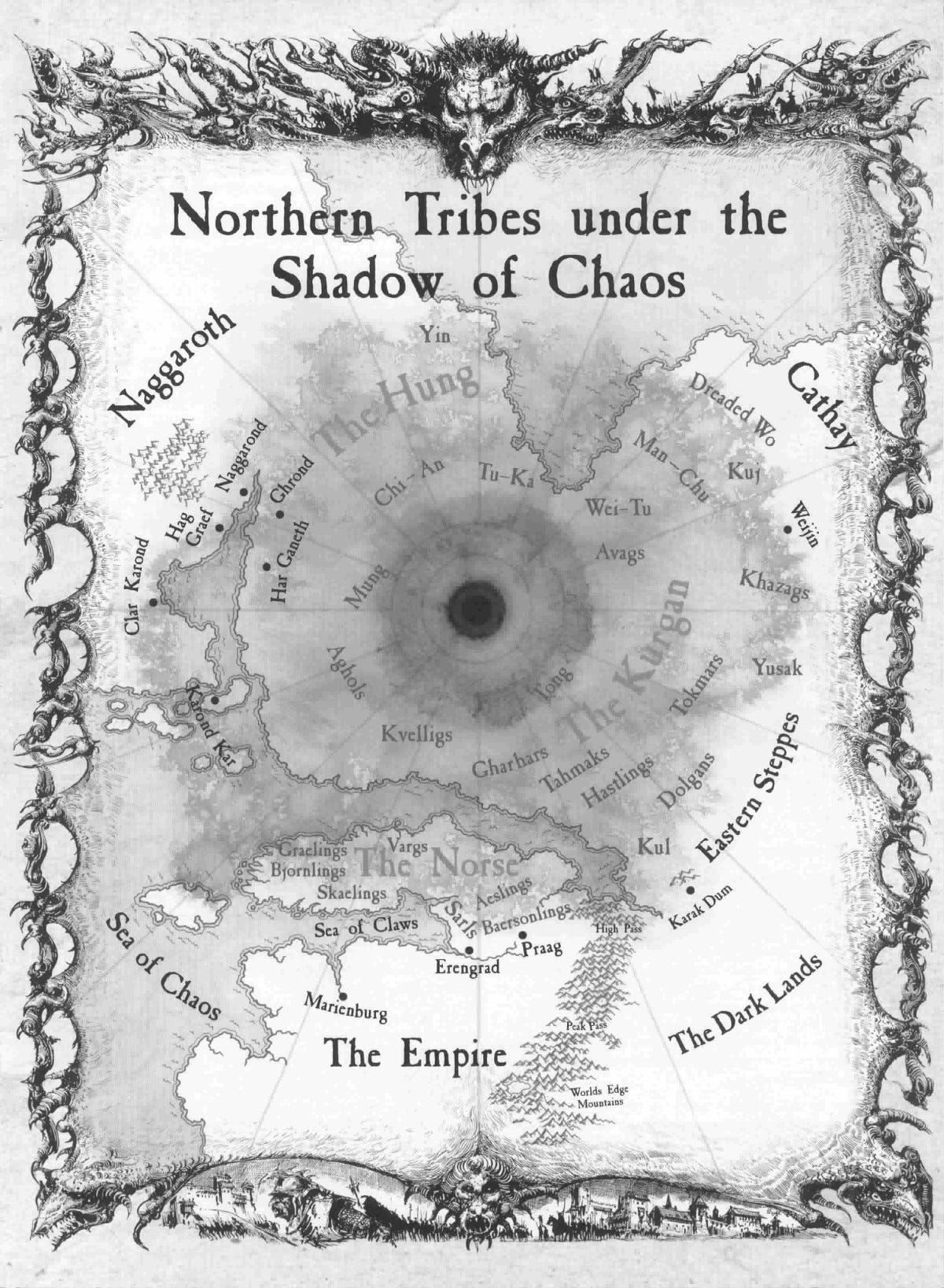
In terms of geography, Warhammer originally adopted a Eurocentric setting from Tolkien’s The Lord of the Rings. This is clear from the maps of The Old World. Ulthuan is equivalent to Atlantis in shape, position, etc. As the home of the Elves, a haughty, proud, yet ultimately declining race of blonde-haired, blue-eyed humanoids, we can say that this presents a portion of the old myth of Hyperborea so often seen in various edits on the Internet. The myth of Hyperborea is still present even when discussing the tribes inhabiting the Chaos Wastes in the northern arctic regions of the Warhammer world. The Chaos Wastes extend across the entire frozen north, and even into the “Eastern Steppes.” The “Northmen” are chaos worshippers in-universe. Perhaps this is a fantastic example of cultural memory preserving a narrative from the margins of political discourse: that of the various steppe peoples of Indo–European fame. I mean, seriously, it’s even got the same name: The Kurgan. As in: The Kurgan Hypothesis.
Even though Warhammer has adopted Chinese, Russian/Slavic civilizations, etc. in the form of Kislev and Grand Cathay, this as yet has not terminally altered the setting. Rather, it could be said to have enhanced it. As I have said, all tropes are present in Warhammer. Warhammer often uses exaggeration to comedic effect. The setting, since it is a form of low culture, never really takes itself too seriously. The Orks are always the comic relief faction. However, with the addition of “Asia” in the Total War: Warhammer III “Immortal Empires” map, I found it hilarious that the Nurgle faction was basically in India. Ku’gath Plaguefather runs the Subcontinent. Imagine the smell.
This brings up an interesting point about the usage of comedy, and about pastiche. Warhammer is a pastiche. In being so comically genuine about its grimdark aspects, it informs us about reality in a way that does not offend. Reality is actually deeply subjective in-universe. If Orks believe red vehicles go faster, it literally becomes true enough that it manifests in reality. You might believe that this is silly, but when on the tabletop there are Orks charging your models, it is your objective reality. As in Warhammer, as in life. Perception is reality. This saying was drilled into my head in Officer Candidate School, and I hate it. But it doesn’t matter. The subjective beliefs of “the other” become your objective reality when that group starts interacting with yours. This deep insight is incredibly important when dealing with James Lindsey types who think that “objective reality” is a ruleset which can be applied evenly worldwide. Aurel Kolnai wrote at length about the subjective vs. objective in philosophical terms in his 1938 book The War Against the West. Essentially, it is a philosophical argument between Kantian thought which seeks to apply a universal “categorical imperative” upon all groups; and a more primordial view, that is to say, that force is the true source of any kind of power. When one group has a certain perception, that alters that group’s reality. It constrains them and grants certain permissions. It impacts their interactions with other groups.
What you believe about yourself and the world in large part determines how you will be treated by others, because it is apparent to them in your attitudes. The transmission of information is returned with feedback, which further may be responded to. In Warhammer, the laws of force, of the jungle, apply. When different factions interact, it’s usually through conflict. How does the resolution of differing perceptions occur? By WAR. Who decides the outcome of battle? The dice, which is to say, THE GODS. Whether Tzeentch, or the Emperor, says yes or no. But aren’t these just endless cycles of reciprocal violence? Well, as they say, Khorne cares not from where the blood flows, only that it flows. If victorious, no one wants to hear critiques of how it could have been done better. If one is defeated, of course, blame and coping follow. Luck of the dice means that nothing can ever be 100% the fault of the player. Anyone who has played tabletop knows this deeply. An excellent tactical plan with a well-constituted, competitive army list can still lose if the dice do not favor.
Another aspect which should be mentioned is the silo-ification of wargaming. As far as Fantasy/The Old World is concerned, this has largely replaced Age of Sigmar. Every nerdy business I.P. is in an unsolvable moral quandary: make profit by appealing to the sensibilities of intelligent, nerdy straight White men; or appeal to the recent tourists which are constituent groups of the progressive rainbow coalition. The way firms have chosen to deal with this is complex, but a pattern has emerged. True oldhead tabletop gamers get their own special space within the I.P. in question. However, the more broadly popular section of the hobby is slowly corrupted. Furthermore, games with ever-larger models (lower model count per army = less painting) and simplified rules are created to bring in the lower-I.Q. tourists. This explains what Age of Sigmar is supposed to be for. It also explains what the Horus Heresy (“30K”) is for as well. Age of Sigmar is to bring in tourists from Dungeons & Dragons, and “30K” is for older neckbeards who want Warhammer to be what it was 15 years ago. Warhammer Fantasy (The Old World) actually has very complex maneuvering rules in comparison to later historical wargames developed by some of the original Warhammer rules writers.
The reason why this is important is that it implies that Games Workshop has realized that it must appeal to the dominant share of its customer base. Even if old characters from the original Fantasy setting are dispensed with, it still exists in a highly perennial format. It is a perfect game with many exploits. The actual models are exactly the same as they were in the 8th edition of Warhammer Fantasy from over a decade ago. They have been brought back in fully plastic kits. That is why it retains its entertainment value. Even if newer female special characters are introduced with greater frequency into the setting, it matters less than might be imagined. Indeed, the opinion that Games Workshop, like most corporate firms, are market laggards because they do not have a dedicated team for market research, is a double-edged sword. “Woke” is slowly being inserted, but it will not last and can easily be retconned.
The stupidity of Games Workshop in bringing back The Old World since the continuation of the video game Total War: Warhammer is incredible. All of the older, well-beloved special characters such as Karl Franz, Archaeon the Everchosen, Thorgrim Grudgebearer, and many others were all present in the video game. Now Games Workshop is telling people that they can no longer buy new kits for all of these older characters in the familiar high-fantasy setting. It was a simple question of easy marketing for a franchise using the video game to sell tabletop miniatures. The marketing team inevitably will get questions about this. We in our circles know that these ostensibly “business” decisions are not actually being made for monetary gain. They are being made for political reasons, first and foremost; good business and marketing sense are secondary goals. The powers that be desire to change Warhammer into something that it is not, and never was, and never will be.
This brings up the next point: the “grim darkness” of the setting is perennial and unchanging. That is what makes Warhammer what it is. You can bring back the primarchs Lion El’Jonson, Roboute Guilliman, etc., and the setting gains only a small glimmer of hope. Despite Warhammer being partially within the Boomer Truth paradigm, and certainly created beneath that paradigm, it cannot be fully contained. Even in fantastic pastiche, it breaks free from the mental bonds placed upon us. Therefore, even if The Old World, as the fantasy setting of Warhammer, obtains at long last a more or less “based” silo of its own, it still matters over the long term. As I understand, Age of Sigmar was never truly popular and didn’t sell particularly well. Warhammer Fantasy just might be profitable. This is good, because profit is a solvent for cultural and political projects. It applies to the Left as much as the Right. As with everything else, you basically have to outlast the current leadership class by making their projects seem nonsensical, unprofitable, etc. to sections of the managerial elite. Our enemies will get some of what they want, but not nearly all of it, and it will be erased through time.
Warhammer is a cultural artefact that has a life of its own. It cannot be destroyed because it is simultaneously too big to destroy, and yet it dwells in the obscured small spaces of disprivileged “low culture.” Because it is a pastiche that doesn’t take itself too seriously, it can be overlooked by casual observers as something unimportant at first glance. The attitude of our enemies, however, now admits that Warhammer is in fact serious business. Warhammer, therefore, is a cultural touchstone — a battleground where progress of The Great Game known as political culture wars may be observed. It allows White men to think briefly about subjects which have been long denied to them: to engage in heroism, accept brotherhood, discuss loyalty, and debate vengeance. Following in the footsteps of Aekold Hellbrass grants one a strange sense — that life sprouts forth no matter what previously has happened to the varied tribes of the European peoples. Fortune’s dice may not smile on us today or yesterday, but tomorrow is always another story, another chance to roll the dice. Life springs eternal from the grass-green tabletop.
The bottom line is the entirety of the European peoples on Earth need to make and transmit Our own culture. Done properly, we can use it to forge a Pan European brotherhood and sisterhood, which is the only way our people are going to survive and have any chance at commanding our destiny from a homeland in which We are the state, rather than as we are now - a stateless people.
Imagine Europeans playing games where they role play as voyagers across the cosmos to conquer a new planet. Imagine them importing labor and then fighting off savagery to bond and identify with Afrikaaners and Americans. Imagine Americans role play as characters clearly taken from Alfred the Great or Charles Martel ... ...
Now let's make that happen and build our own games, movies, recording industry and create our own distribution and cultural transmission mechanisms.
Carpe Diem